
Bohuslav Martinů (1890-1959) was born in the tower of St. Jakub Church in the small Bohemian town of Polička. He was a notoriously bad student at the Prague Conservatory, where he studied violin but was more interested in composing. Briefly, he was a member of the second violin section of the Czech Philharmonic. In 1923, he moved to Paris, where he studied with Albert Roussel and began to compose extensively. Following the German occupation in 1940, Martinů emigrated to New York. After the war, he was offered a teaching position at the Prague Conservatory, and he nearly returned home, but it was not meant to be. During the summer of 1946, while teaching at Serge Koussevitzky’s Berkshire Music School, Martinů suffered a near-fatal fall from a balcony.
It was in 1947, during a period of convalescence following the accident, that Martinů composed the Three Madrigals for violin and viola. The work was dedicated to Joseph and Lilian Fuchs, the renowned brother-sister violin-viola duo. Martinů was inspired to write the Madrigals after hearing the Fuchs’ perform Mozart Duos. He loved English madrigals, and these Renaissance influences are evident, along with the zesty rhythms and inflections of Czech folk music.
The first Madrigal (Poco allegro) is a blazing perpetual motion filled with alternating interjections between the two instruments. A lamenting dumka, the second Madrigal (Poco andante) begins with ghostly trills, and a sense of mystery. The final moments arrive at a passionate climax, followed by repose. The final Madrigal (Allegro) has been described as “an exuberant mashup of hoedown and Bach invention.” (John Henken) There are humorous references to Beethoven’s “Pastoral” Symphony, and the Baroque counterpoint of Vivaldi.
This performance, recorded in 2020 by Leonart Studio, features Bartek Niziol (violin) and Michel Willi (viola):
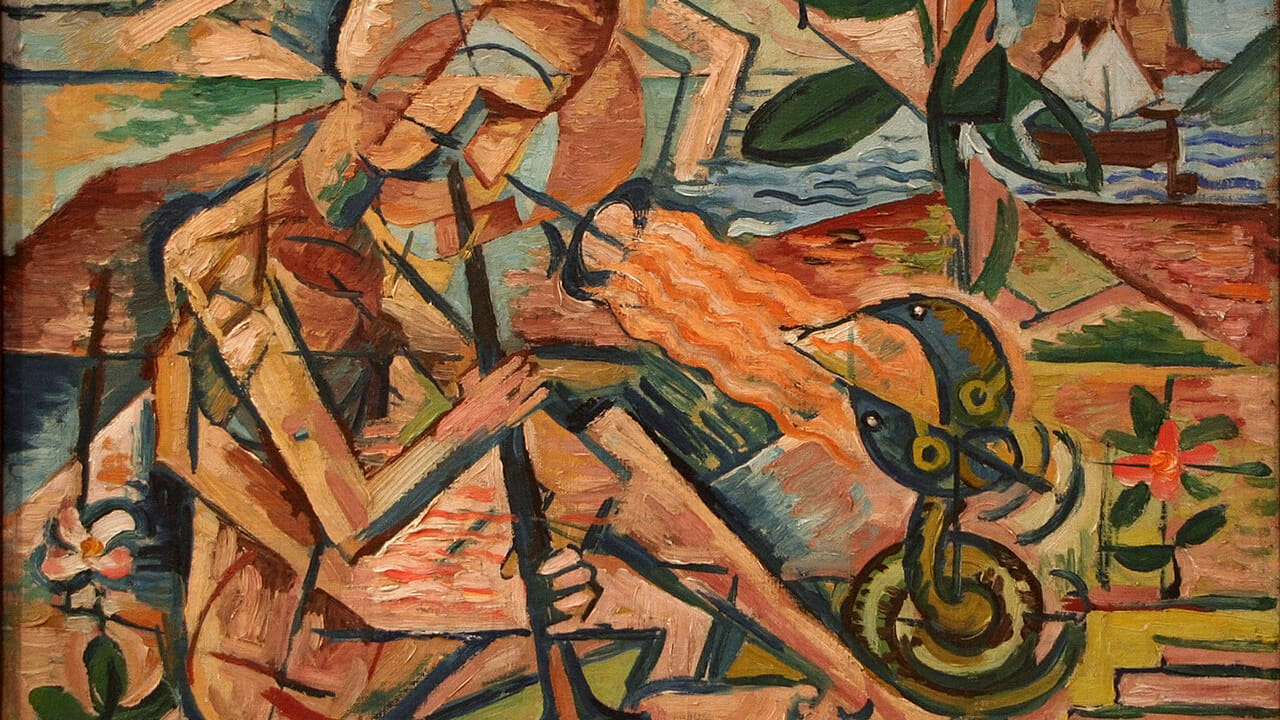
Featured Image: “Fakir Taming Snakes” (1915), Bohumil Kubišta