
For Claude Debussy, the ghost of French Baroque composer Jean-Philippe Rameau (1683–1764) loomed large.
An innovative composer of opera and harpsichord music, Rameau’s influential 1722 Treatise on Harmony earned him the nickname, the “Isaac Newton of Music.” In 1903, Rameau’s 1737 opera, Castor et Pollux, was performed in Paris. Debussy, in the audience, was heard to exclaim, “Long live Rameau, and down with Gluck!”
Hommage à Rameau is the second piece in Book I of Debussy’s keyboard suite, Images, composed in 1905. It is a dreamy and haunting remembrance of an idealized past. Marked lent et grave (slow and solemn), the music unfolds with the slow, stately, triple-meter rhythm of the Baroque sarabande. Listeners have described it as a “shamanistic dance” or a “solemn procession.”
In the opening, a quietly melancholy modal theme emerges in octaves. Soon, it pulls us into a world of sensuous harmony. Chords float tenuously and take sudden, unexpected turns. Having studied Rameau’s Treatise, Debussy writes a bold and exotic new chapter, embracing the wonder of harmony and the expressive power of a single chord.
This celebrated 1990 recording features Hungarian pianist Zoltán Kocsis:
Recordings
- Debussy: Images I, CD 105: II. Hommage à Rameau, Zoltán Kocsis Amazon
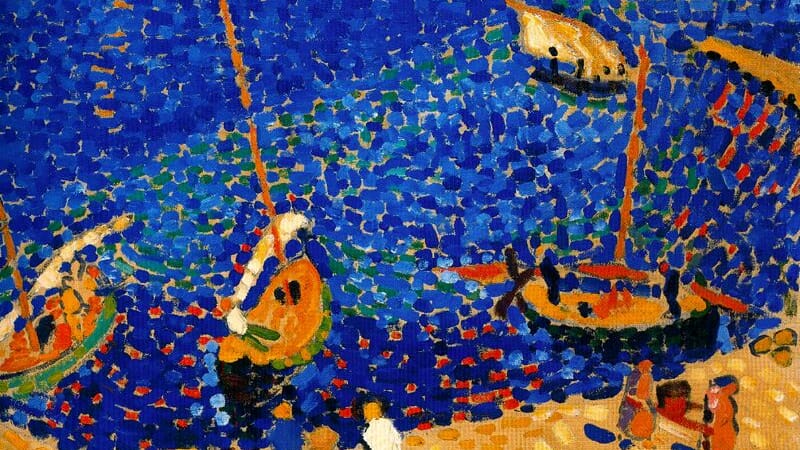
Featured Image: “The Port of Collioure” (1905), Andre Derain