
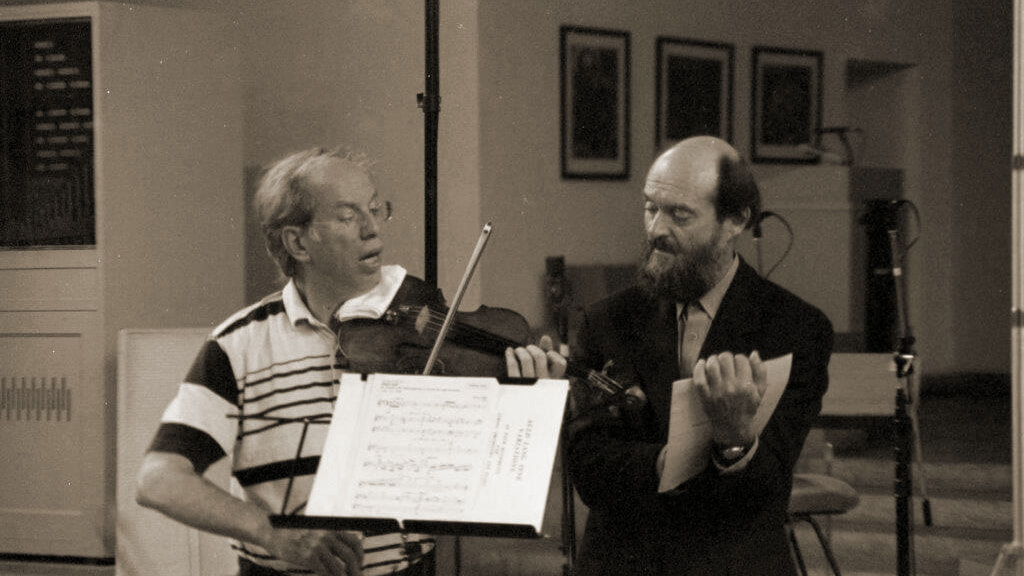
Fratres, meaning “brothers” in Latin, has been described as “a mesmerizing set of variations on a six-bar theme combining frantic activity and sublime stillness.”
Composed in 1977 by Estonian composer Arvo Pärt (b. 1935), Fratres is set in three parts, without fixed instrumentation. With the serene timelessness of medieval organum, a chant-like melody floats over a drone made up of the pitches A and E. A percussive motif recurs between chord sequences. The structure adheres to mathematical rules regarding the movement of voices and alternations of time signature.
This is the music which emerged following Pärt’s years of compositional silence. For the composer, tonality and modernist complexity hit a brick wall with the 1968 Credo. What followed was the spiritual minimalism of tintinnabulation. Pärt writes,
I work with very few elements – with one voice, with two voices. I build with the most primitive materials – with the triad, with one specific tonality. The three notes of a triad are like bells. And that is why I call it tintinnabulation.
Tintinnabulation is an area I sometimes wander into when I am searching for answers – in my life, my music, my work. In my dark hours, I have the certain feeling that everything outside this one thing has no meaning. The complex and many-faceted only confuses me, and I must search for unity. What is it, this one thing, and how do I find my way to it?
This recording features violinist Gidon Kremer and pianist Keith Jarrett:
Recordings
- Pärt: Fratres Gidon Kremer, Keith Jarrett Amazon
Fantastic Fratres – double the Arvo Part! And again, from this timeless ECM New Series release. Kremer, Jarrett, and Part (and Timothy) help us understand the quote on the album above:
You wish to see; Listen. Hearing is a step towards vision.
Thank you Timothy
Great archival photo, BTW.
Upon each hearing, I am brought to tears. Similarly, but not as intensely for me, is “Spiegel in Spiegel.”