
Typically, a musical canon involves a melodic line which is imitated by one or more voices after a set duration, resulting in a magical contrapuntal layering.
In the chorale prelude for organ, O Lamm Gottes, unschuldig (“O Lamb of God, innocent”), BWV 618, Bach expanded on this idea by creating a canon “alla quinta” (“canon at the fifth”). Unlike a canon in unison, the voices are set a fifth apart. In this case, the Lutheran chorale melody occurs in the inner voices between the alto and tenor.
In their recent program note, the Netherlands Bach Society writes,
After a few bars of the prelude, first the tenor speaks, and then five tones higher (and two beats later) the alto. The rules of the canon are clear: the melody remains constant, even if that produces sharp dissonants or ‘forbidden’ twists. Such a distance between the voices therefore often leads to harmonic tension, and even more so if a melody has not been specially designed for a canon, as in the case of a chorale.
Sighing motifs can be heard in the accompanying voices. The blur of voices evokes a sense of mystery and melancholy which mirrors the hymn’s religious text.
Bach used this melody as the cantus firmus in the opening chorus of the St. Matthew Passion. BWV 618 comes from Orgelbüchlein (“Little Organ Book”), Bach’s collection of 46 chorale preludes.
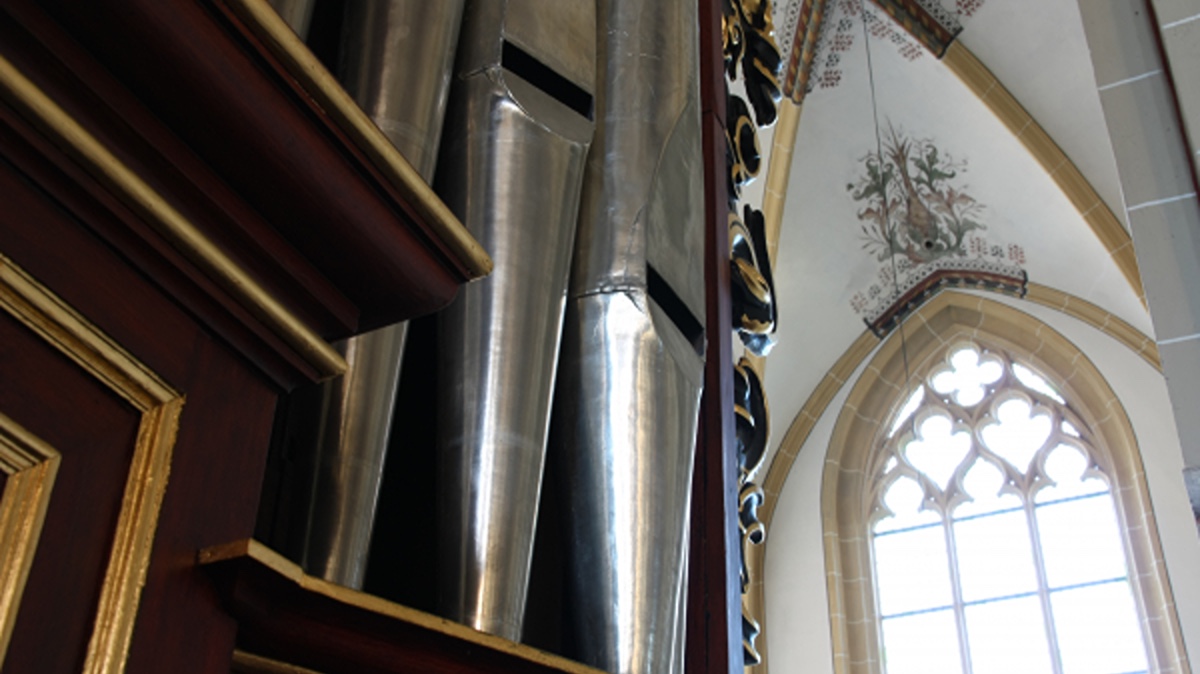
Recorded by the Netherlands Bach Society on May 27, 2024 at Walburgiskerk, Zutphen, this performance features organist Leo van Doeselaar. The instrument was made by Henrick Bader between 1639 and 1643.
J.S. Bach: Goldberg Variations, BWV 988: Var. 15, Canone alla quinta
Another canon alla quinta unfolds in the fifteenth variation of Bach’s Goldberg Variations. Pianist Glenn Gould said,
It’s the most severe and rigorous and beautiful canon…the most severe and beautiful that I know, the canon in inversion at the fifth. It’s a piece so moving, so anguished—and so uplifting at the same time—that it would not be in any way out of place in the St. Matthew’s Passion; matter of fact, I’ve always thought of Variation 15 as the perfect Good Friday spell.
In the final measures, the pianist’s hands move to the lowest and highest registers of the keyboard, and we are left with an open fifth.
Recordings
- J.S. Bach: Goldberg Variations, BWV 988, Murray Perahia Amazon
- Glenn Gould’s performance
This is one of the Bach pieces I learned as a teen. I return to it often. Thank you for highlighting it.