
After hearing Antonín Dvořák’s String Sextet in A Major, Op. 48 in 1941, conductor Václav Talich was overcome with the pure beauty of the work, exclaiming, “Beautiful musical ideas, a beautiful structure and a beautiful sound! God himself must have been walking the Czech Lands when his humble servant Dvořák bequeathed to us a work of such excellence and sanctity…”
Filled with the Slavonic folk influences, the Sextet is the enchanting music of a Czech fairytale. It overflows with sunny melodies and adventurous modulations which might remind you of the chamber music of Schubert. Dvořák composed it in fourteen days in May of 1878, after completing the piano version of the first set of Slavonic Dances, the Bohemian miniatures which would bring him widespread fame. The string sextet, first pioneered by Brahms, is made up of two violins, two violas, and two cellos. It is an instrumental combination which carries a unique sonic warmth, depth, and richness.
The renowned Hungarian violinist, Joseph Joachim, was an enthusiastic champion of the work. Following a private performance of the Sextet on July 19, 1879, organized by Joachim, Dvořák wrote,
…Joachim waited with eagerness for my arrival and even organized a soirée for my sake. During the celebration they played my new quartet and sextet. They played with great understanding and enthusiasm…
The first movement (Allegro moderato) begins with a theme which is quiet, nostalgic, and tinged with melancholy. At moments, there are intimations of the open fifths of distant hunting horns. Misha Amory, violist of the Brentano String Quartet, notes that, in this movement, Dvořák enters into a free-spirited compositional experiment: “…instead of giving each of his two themes a separate lengthy section, as would be standard procedure, he alternates them more tightly, so that they recur around each other in a kind of negotiation, the sighing, singing first melody against the nimble, dancing second one.” There is a naturalness to this music which gives us the sense that it can only unfold in this way. After many adventures, the final bars drift away with a serene cadence which evokes a liturgical chorale.
The second movement (Dumka. Elegie) is poised between lament and joy. Originating in Poland and the Ukraine, the dumka is a sorrowful Slavic ballad which contains a contrasting lively section. Dvořák’s dumka unfolds in asymmetrical five-bar phrases. Gently sighing gestures emerge in the inner voices.
The third movement (Furiant. Presto) is an exuberant folk dance. Set in 3/4 time, the furiant is a rapid Bohemian dance punctuated with irregular rhythms and off-beat accents. Misha Amory observes that the movement is free of shadows, “just flirtation, the dance, and a few oafish grunts from the low instruments at the very end.” Listen for the interplay between the first violin and the inner voices, which occasionally respond in echoing canonic counterpoint.
The final movement (Finale, Tema con variazioni) follows in the footsteps of Beethoven, who was fond of concluding works such as the Eroica Symphony with theme and variations. The diverse variations traverse an array of musical landscapes, moving between minor and major, and venturing into modal territory. The coda arrives in a brilliant flash of wild virtuosity. We are left with the spirited strains of a Bohemian fiddler.
This recording features Sarah Chang (violin) Bernhard Hartog (violin) Wolfram Christ (viola) Tanja Christ (viola) Georg Faust (cello) Olaf Maninger (cello):
I. Allegro moderato:
II. Dumka. Elegie:
III. Furiant. Presto:
IV. Finale, Tema con variazioni:
Recordings
- Dvořák: String Sextet in A Major, Op. 48, Sarah Chang, Bernhard Hartog, Wolfram Christ, Tanja Christ, Georg Faust, Olaf Maninger Amazon
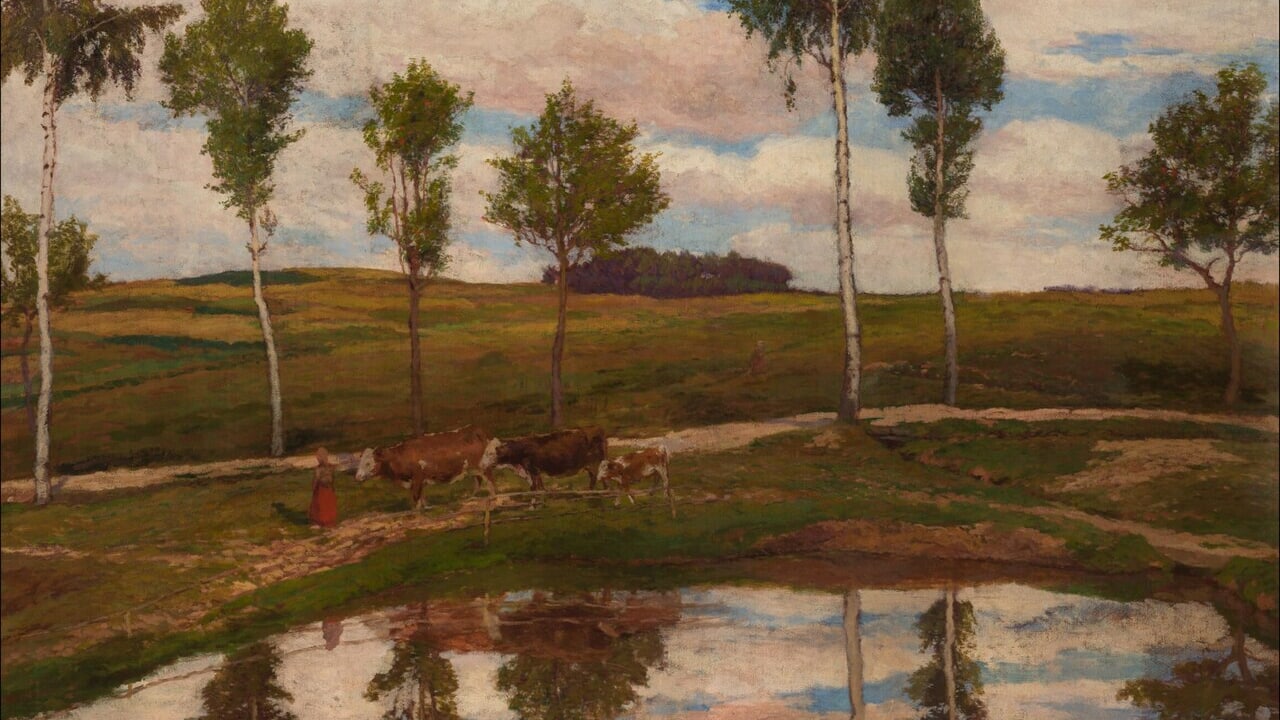
Featured Image: “At Home in Kameničky” (1904), Antonín Slavíček