
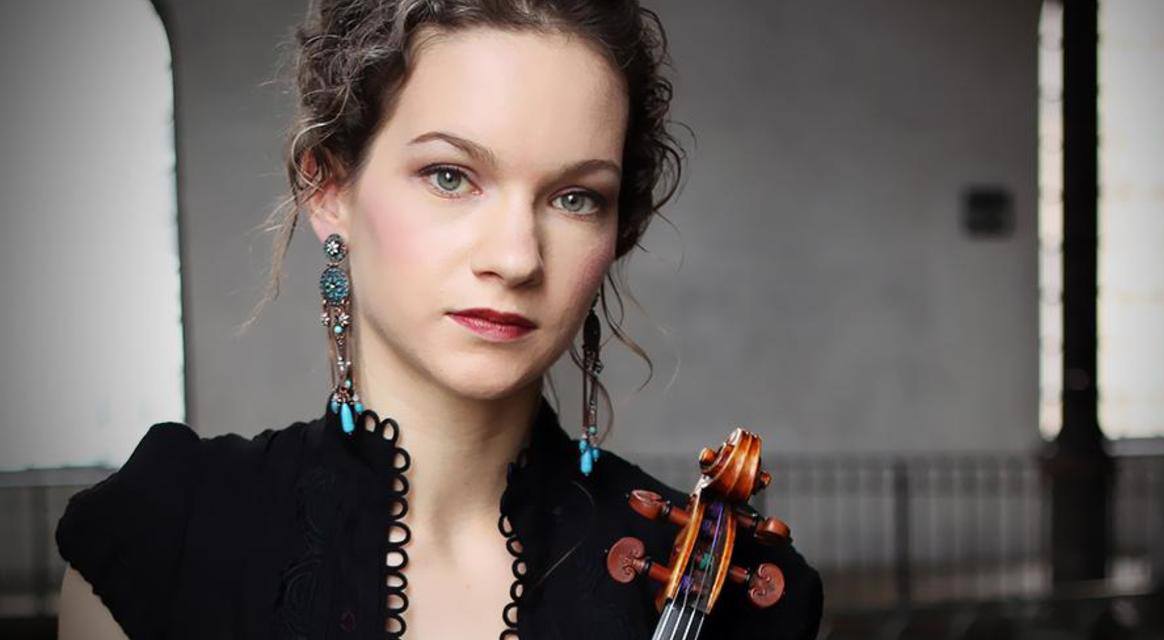
“Bach has played a long part in my musical life,” said violinist Hilary Hahn in a 2018 interview. “I started playing the solo Bach Sonatas and Partitas when I was nine in preparation for a couple of movements that I played on my first full recital when I was ten, and shortly after that I started at Curtis…”
While Bach’s six groundbreaking Sonatas and Partitas showcase the violin as an instrument capable of intricate polyphony, his three surviving violin concertos create a magical dialogue between soloist and orchestra. Bach absorbed the towering influence of Vivaldi, and then pushed the Baroque concerto into new territory. There are more key changes, more complex counterpoint, and an occasional blurring of the solo sections and the orchestra’s recurring tutti ritornello.
Bach’s Concerto in A minor, BWV 1041 was probably written during his time in Cöthen (1717-1723), or immediately after in Leipzig. It may have been performed on the influential concert series at Leipzig’s Café Zimmermann coffeehouse. Bach was likely the soloist.
From the first notes of opening Allegro, a vibrant imitative musical conversation emerges between the violins and basso continuo. Propelled forward by an ostinato heartbeat, the second movement (Andante) is a tender aria. It ventures into mysterious and shadowy places before returning home. The final movement (Allegro assai) is an exhilarating gigue. In the final moments, the solo violin becomes a fiddle and engages in a wild bariolage (a rapid alternation of notes on adjacent strings).
Hilary Hahn approaches the A minor Concerto with free spirited joy and gusto. She has said, “I’m not the Bach police — I don’t believe in the idea that there is any one way to play Bach ‘correctly.’ I love any approach performed well, with conviction, vision, and forethought.”
Here, she joins Omer Meir Wellber (conducting from the harpsichord) and the Deutsche Kammerphilharmonie Bremen:
He heard the slightest wrong note even in the largest combinations. As the greatest expert and judge of harmony, he liked best to play the viola, with appropriate loudness and softness. In his youth, and until the approach of old age, he played the violin cleanly and penetratingly, and thus kept the orchestra in better order than he could have done with the harpsichord. He understood to perfection the possibilities of all stringed instruments.
– Carl Philipp Emanuel Bach describing his father, J.S. Bach, in a 1774 letter to Johann Nicolaus Forkel who wrote the first biography of Bach.
Thank you for the article. Indeed, I prefer this performance over the recording Hilary Hahn released in 2003. This rendition seems more measured and more nuanced than the one on her CD. (Of course, Hahn is older here.) For me, an even bigger treat is the follow-up album of Bach’s solo works that she released in 2018. What a knockout!