
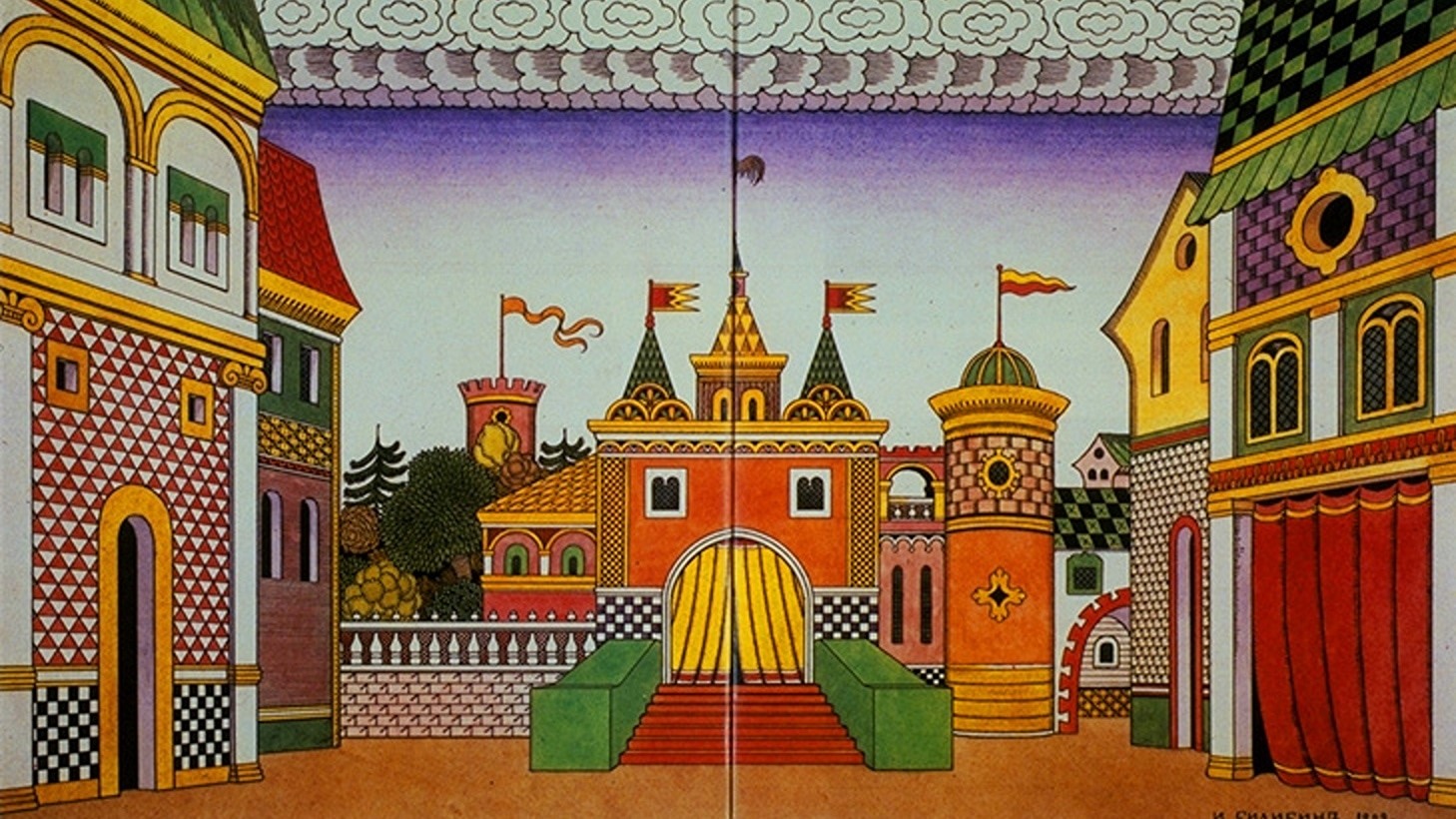
Completed in 1907, The Golden Cockerel was the last opera of Nikolai Rimsky-Korsakov.
Based on an 1834 poem by Alexander Pushkin, its fairytale plot unfolds over three acts, bookended by a prologue and epilogue. The story involves the bumbling Tsar Dodon. “Advised by an Astrologer, Dodon uses a magical cockerel (a young male rooster) to warn of threats, but his incompetence leads to his sons’ deaths and his infatuation with the treacherous Queen of Shemakha, ending in his downfall.” The opera was a thinly veiled satire on the 1905 Russian Revolution and the fall of Tsar Nicholas II.
Hymn to the Sun
The opera’s most famous aria, Hymn to the Sun, comes in the third act. It is sung by Queen of Shemakha as she seduces Tsar Dodon. Exotic, slithering chromatic lines, introduced by the clarinet in the introduction, signal danger and manipulation. Having caused the deaths of the Tsar’s sons, the Queen emerges from her tent to enchant the foolish Tsar, who falls under her spell.
The Golden Cockerel Suite
Following Rimsky-Korsakov’s death in 1908, Alexander Glazunov and Maximilian Steinberg created an orchestral suite from the opera. The Suite’s four movements are filled with exotic sounds which evoke the Orient, and Rimsky-Korsakov’s glittering technicolor orchestration.
Throughout the opera, characters are depicted through instrumental voices. The first movement (Tsar Dodon in His Palace) begins with a fanfare, played by strident muted trumpets and woodwinds, representing the magical Cockerel. As the shimmering music progresses, we are drawn into a dark, distant fairytale world.
The second movement (Tsar Dodon on the Battlefield) begins with ominous and shivering lines. Comic and grotesque, the music accompanies the Tsar’s inspection of the aftermath of a battle.
The third movement (Tsar Dodon as the Guest of the Queen of Shemakah) may remind you of the third movement of Nikolai Rimsky-Korsakov’s Scheherazade. With echoes of Russian folk music, it begins with a sensuous, wandering melody.
In the final movement (The Wedding and Lamentable End of Dodon), joyous celebration reaches a tragic climax. Ringing out in the muted trumpets, the Cockerel has the final word.
Recorded in February of 2020, this performance features Alain Altinoglu and the Frankfurt Radio Symphony:
Hymn to the Sun (Arranged by Fritz Kreisler)
Violinist Fritz Kreisler created an arrangement of Hymn to the Sun. This classic recording features Kreisler, accompanied by pianist Franz Rupp:
Recordings
- Rimsky-Korsakov: The Golden Cockerel: Hymn to the Sun, Aida Garifullina, RSO-Wien, Cornelius Meister Amazon
- The Kreisler Collection (The HMV Recordings with Franz Rupp, 1936-38) Amazon
Featured Image: Ivan Bilibin’s 1909 stage set design for Act II of “The Golden Cockerel”: The Tsardom of Tsar Dodon, Town Square