
Mozart’s Piano Concerto No. 9 in E-flat Major, K. 271 is revolutionary music filled with dramatic surprises.
It has been called “one of the greatest wonders of the world” (Alfred Brendel), “perhaps the first unequivocal masterpiece of the classical style” (Charles Rosen), “Mozart’s Eroica” (Alfred Einstein), and the concerto in which “Mozart, so to speak, became Mozart” (Michael Steinberg).
The 21-year-old Mozart composed this music in January of 1777, months before he would leave provincial Salzburg in search of a better job. The work’s nickname, “Jeunehomme,” is erroneous. In a letter, Mozart referred to the Concerto as “the one for the Jenomy.” It was assumed that this was a misspelling, referring to an unknown French pianist. In 2004, musicologist Michael Lorenz proved that the dedicatee was Victoire Jenamy (1749-1812), a talented amateur pianist and the daughter of dancer and Paris ballet master Jean-Georges Noverre.
Pianist Angela Hewitt writes that Noverre “brought drama into ballet, taking it away from its courtly origins and creating the ‘ballet d’action’ which told of human emotions,” while Mozart “opened up another world of the piano concerto with this piece written for his daughter. Gone are the gestures made purely to please; in comes the most profound lyrical outpouring imaginable.” She also observes that this is music emphatically for the “fortepiano and not a harpsichord—something which is obvious from the number of dynamic markings in the solo part.”
The biggest surprise comes moments into the first movement (Allegro). The orchestra’s brief call to order is followed immediately by the solo piano’s cheerful entrance. For listeners at the time, this would have seemed like a shocking intrusion on the expected orchestral introduction (ritornello) in which the movement’s themes are introduced. In the final bars of the introduction, again the piano enters early with a trill, blurring the lines between solo and accompaniment. We are drawn into a sunny operatic scene in which instrumental voices have replaced singers. As a result of the dramatic weave of conversing voices, the work’s modest scoring (strings, two oboes, and two horns) feels more expansive. Hewitt writes,
At key points the piano is accompanied only by oboes; at another the first horn doubles the soloist. The abundant themes are thrown around from part to part with an astonishing ease. In fact a soloist playing from memory can easily get mixed up in Mozart’s games, forgetting to play something that earlier was given to the orchestra. One theme, first introduced in bar 47, foreshadows the recitative-like passages to come in the next movement.
Anticipating later Concerti of the Romantic period, Mozart did not leave the cadenzas to improvisation, but instead wrote them out. In the final bars, the solo piano delightfully intrudes on the expected orchestral close with a return of the trill and an exuberant final flourish.
With muted strings, the second movement (Andantino) moves to haunting C minor. Amid the ghostly lines, there are wrenching dissonances. A tragic aria interspersed with recitative passages, this is music which anticipates the pathos of the Romantic period. “The lead-in to the cadenza, usually the domain of the orchestra, is given over at the crucial moment to the piano,” writes Hewitt. “The cadenza itself is a miracle of expression, giving a brief second of hope before resolving into almost unbearable pain.”
Opening with an expansive 34-bar theme, the final movement (Presto) is a sunny rondo. Mozart has one more surprise up his sleeve. Midway through, the forward motion dissipates to be replaced by a cantabile minuet, accompanied by graceful pizzicati in the strings. Perhaps it is a touching nod to the ballet master, Jean-Georges Noverre. The movement ends with a return of the adventure-filled Presto. The final bars of the coda seem to gallop into the sunset.
I. Allegro:
II. Andantino:
III. Rondeau (Presto) – Menuetto:
Five Great Recordings
- Mozart: Piano Concerto No. 9 in E-flat Major, K. 271, “Jeunehomme” Alfred Brendel, Sir Charles Mackerras, Scottish Chamber Orchestra Amazon
- Angela Hewitt and the Orchestra da Camera di Mantova
- Murray Perahia and the English Chamber Orchestra
- Mitsuko Uchida with Jeffrey Tate and the English Chamber Orchestra
- Vladimir Ashkenazy with István Kertész and the London Symphony Orchestra
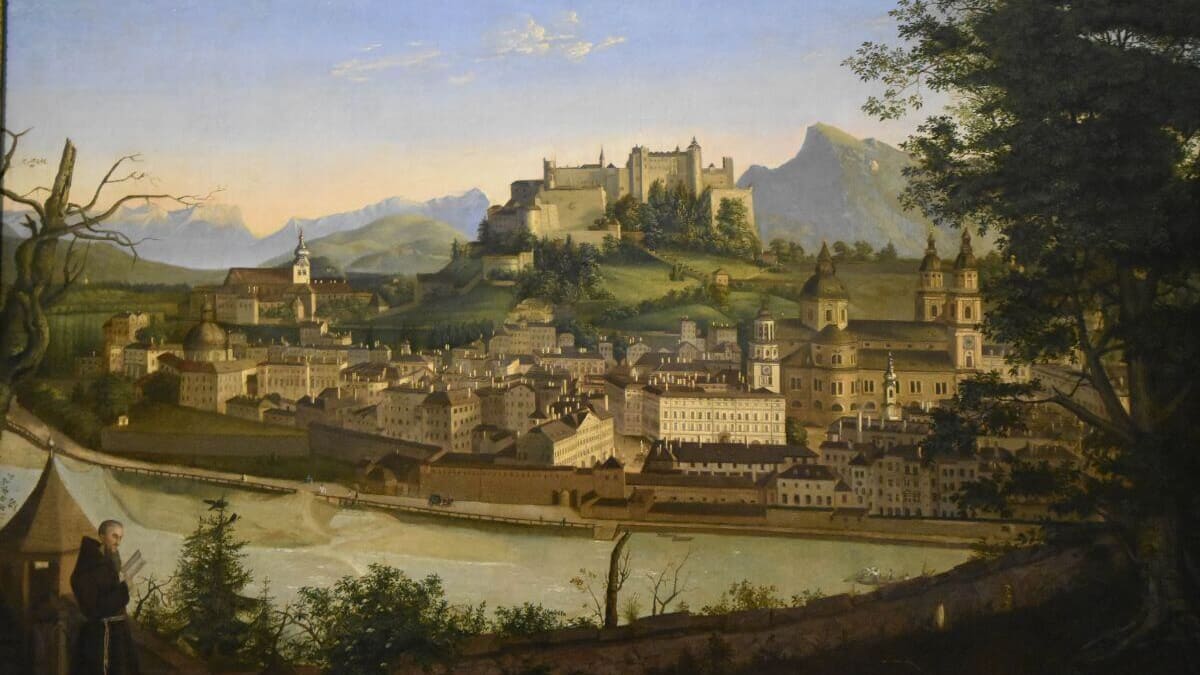
Featured Image: “View of Salzburg” (1835), Franz Xaver Mandl
So beautiful to hear this exquisite concerto the first thing in the morning. The backstory is so interesting! A great way start to the day.