
The title, The Young Person’s Guide to the Orchestra, Op. 34 describes a narrator-driven work which brilliantly introduces the instruments, showcasing their distinct tonal colors and personas. The subtitle, Variations and Fugue on a Theme by Purcell, suggests a concert piece which stands on its own without narration.
Benjamin Britten’s Young Person’s Guide functions on both levels. It was commissioned for a 1946 British documentary film, Instruments of the Orchestra. Directed by Muir Mathieson, the film featured conductor Malcolm Sargent and the London Symphony Orchestra. The narration was written by Eric Crozier, who directed Britten’s 1945 opera, Peter Grimes.
Reaching back nearly 300 years, Britten based the work on a theme by English Baroque composer Henry Purcell (1659-1695). The stately rondeau in D minor is part of a collection of incidental music which makes up Purcell’s Abdelazer suite. The Young Person’s Guide begins with a majestic statement of the theme, played first by the full orchestra, and then by instrumental families. Moving from the highest voice to the lowest, the adventurous, far-flung variations showcase the woodwinds, strings, brass, and percussion.
William E. Runyan writes,
Of particular interest is how Britten forges simple accompaniments from totally different instruments to contrast with the featured instrument in its solo variation. So, for example, the clarinets are accompanied by the tuba; the violas by the brass; the basses by woodwinds and percussion; the trumpets by snare drum and pizzicato strings; and so on.
The work concludes with a spectacular fugue for the entire orchestra. With exuberant swirling lines, it is one of the greatest romps every written for orchestra. Some voices pick up the subject as if they are joining a party. In other cases, such as the brass, new voices playfully nudge aside the preceding instrument to enter the spotlight. In the final dizzying moments, Purcell’s original theme is restated by the brass in 3/2 time, this time in triumphant D major, while the rest of the orchestra continues with the breathless fugue in 2/4 time.
Malcolm Sargent led the Liverpool Philharmonic in the concert premiere on October 15, 1946. This 2021 recording, without narration, features the Royal Liverpool Philharmonic Orchestra, led by Vasily Petrenko:
I. Theme:
II. Variations for Woodwinds:
III. Variations for String Instruments:
IV. Variations for Brass Instruments:
V. Variation for Percussion:
VI. Fugue:
Recordings
- Britten: The Young Person’s Guide to the Orchestra (Variations & Fugue on a theme by Purcell) Op. 34, Vasily Petrenko, Royal Liverpool Philharmonic Orchestra vasilypetrenkomusic.com
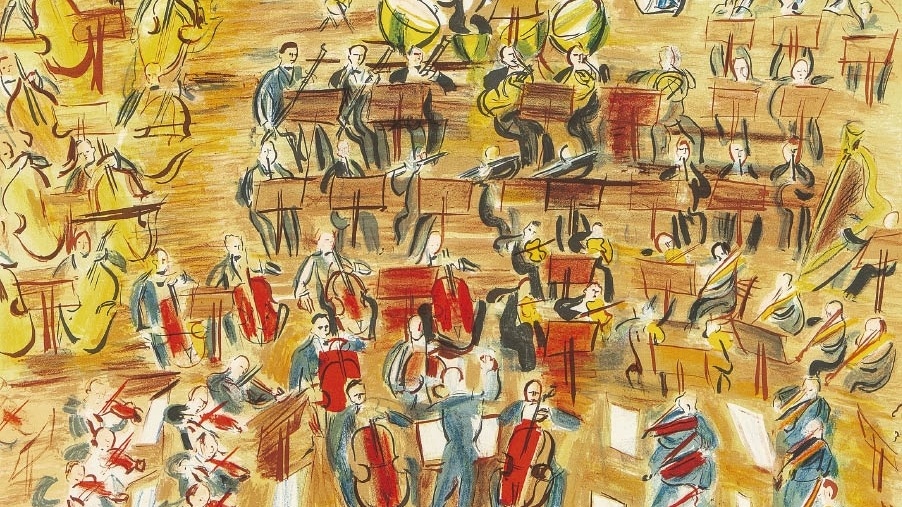
Featured Image: “Concert des Anges” (1963), Raoul Dufy