
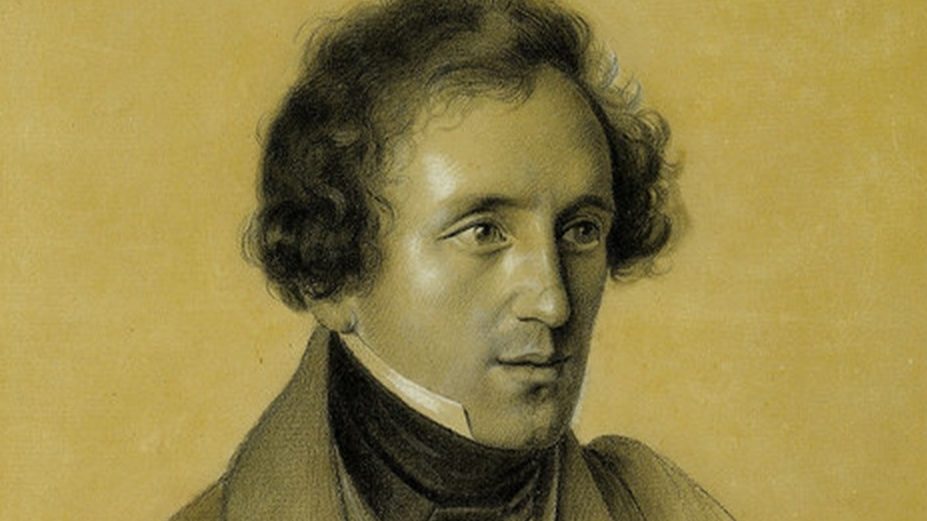
We don’t know any of the details—not even her name, but in 1827, the 18-year-old Felix Mendelssohn seems to have fallen head over heels in love.
In June of that year, Mendelssohn was inspired to write the words and music for a love song called Frage, Op. 9, No. 1 (“Question”). The brief song is filled with questions. It begins with tentative, teasing phrases (“Ist es Wahr?”) and concludes with a serene plagal cadence which evokes the final bars of Mendelssohn’s Overture to A Midsummer Night’s Dream, written a year earlier.
This performance features lyric soprano Sophie Bevan, accompanied by Julian Milford.
Here is an English translation of the text:
Is it true? Is it true
that over there in the leafy walkway, you always
wait for me by the vine-draped wall?
And that with the moonlight and the little stars
you consult about me also?Is it true? Speak!
What I feel, only she grasps-
she who feels with me
and stays ever faithful to me,
eternally faithful.
The song provided the seed for Mendelssohn’s String Quartet No. 2 in A minor, Op. 13, composed a few months later. The first movement’s opening Adagio concludes with the song’s halting initial three notes (“Ist es Wahr?”). The motif returns in various guises in all four movements. The final movement concludes with a tender restatement of the opening theme. Benedict Taylor observes that the Quartet “is the most through-going easy in cyclic form, both by Mendelssohn and by any composer up to that time, until the late works of Franck at the very least.”
Mendelssohn wrote to a friend,
The song that I sent with the quartet is its theme. You will hear it – with its own notes – in the first and last movements, and in all four movements you will hear its emotions expressed. If it doesn’t please you at first, which might happen, then play it again, and if you still find something ‘minuetish,’ think of your stiff and formal friend Felix with his tie and valet. I think I express the song well.
1827 was also the year of Beethoven’s death, and the year in which his last five string quartets appeared in print. Most, including Mendelssohn’s father, dismissed these mysterious cosmic works as (in the words of the violinist Louis Spohr) “indecipherable, uncorrected horror.” For Mendelssohn, they were deeply influential. From the opening Adagio, to the the time-altering expanse of the second movement, and the sudden emergence of an operatic recitative in the final movement, String Quartet No. 2 follows in the footsteps of Beethoven’s Op. 132 Quartet, also set in A minor.
The first movement’s opening A major Adagio introduction gives way to the stormy and restless A minor of the Allegro vivace. The coda ends with growling ferocity in the cello, and the first violin breaking off in a tragic operatic statement.
The second movement (Adagio non lento) begins with a tender and majestic song without words. Its warmth is soon supplanted by a mysterious fugue subject, introduced by the viola. “It is doubly unsettling for being rhythmically puzzling,” writes Howard Posner. “Though the basic rhythm is in three, the fugue subject is seven beats long, and the next voice unexpectedly enters as the first one reaches the seventh beat.” The fugue moves through a series of ever-intensifying variations until the motion halts with a jarring climax and a passionate operatic statement by the first violin. The hymn-like initial music returns and soon combines with strands of the fugue, now a dreamy memory.
The third movement (Intermezzo. Allegretto con moto) begins with a simple, stately melody, accompanied by pizzicati. The middle section shimmers with the nocturnal magic and fairy dust of Mendelssohn’s A Midsummer Night’s Dream. Even as the initial music returns, the movement concludes with a sudden splash of this magic dust.
All that came before is swept aside with a sudden and dramatic operatic recitative in the opening of the final movement (Presto). The dramatic statements are still interspersed with nocturnal fairy music. Themes from the preceding movements, including the second movement’s fugue, return amid a tempestuous whirlwind. In the final moments, the furious counterpoint fades away, and we are left with the solitary voice of the violin. The work comes full circle with a return of the first movement’s opening Adagio. This time, it is shrouded in tender nostalgia. In a way similar to the song, Frage, final bars fade away into serene repose.
I. Adagio – Allegro vivace:
II. Adagio non lento:
III. Intermezzo. Allegretto con moto:
IV. Presto:
Recordings
- Mendelssohn: Frage (Ist es Wahr?), Op. 9 No. 1, MVW. K 39, Sophie Bevan, Julian Milford Amazon
- Mendelssohn: String Quartet No. 2 in A Minor, Op. 13, MWV R22, Quatuor Ébène Amazon
Featured Image: Felix Mendelssohn (1834), Friedrich Wilhelm Schadow