
Anton Bruckner’s sacred motet, Ecce sacerdos magnus, WAB 13 (“Behold a great priest”) begins with an earth-shattering announcement, set in motion by primal open fifths.
The Old Testament text celebrates the blessings given to devout men. Scored for eight-part choir, organ, and three trombones, it is music of thunderous power, majesty, and solemn mystery. Growing out of Medieval plainchant, its soaring antiphonal blocks of sound recall the Renaissance strains of Giovanni Gabrieli. As with Bruckner’s symphonies, there are moments of reverberation and silence. Each episode examines the same mighty edifice from a new perspective. Early in the motet, we hear the radiant six-note “Dresden Amen.” The final moments drift into serene reassurance.
The motet has been called “one of Bruckner’s crowning achievements in the small forms,” and “a work of almost barbaric intensity.” (Keith William Kinder) Commentator Robert Kirzinger hears the expressive power of Bruckner’s symphonic writing. He writes,
The piece is a responsorial, in which a smaller group replies to the pronouncement of a larger one, creating an inherent alternation of textures. The musical idea of the opening unison phrase returns to bind the setting together. Bruckner underlines the ancient origin of the text and his own practice by including a bare plainchant passage within the piece.
A devout Catholic and organist, Bruckner composed the motet on April 28, 1885 during the period when he was writing the Eighth Symphony. It was intended as a processional to be performed for the 100th anniversary of the founding of the diocese at Linz Cathedral. Ultimately, it was not used, and Bruckner never heard it performed during his lifetime.
Here is an English translation of the text, taken from the Biblical book of Ecclesiasticus:
Behold a great priest who in his days pleased God:
Therefore by an oath the Lord made him increase among his people.
He gave him the blessing of all nations, and confirmed His covenant upon his head.
Therefore by an oath the Lord made him to increase among his people.
Glory be to the Father and the Son and to the Holy Ghost…
Recordings
- Bruckner: Ecce sacerdos magnus, WAB 13, Nigel Short, Tenebrae tenebrae-choir.com
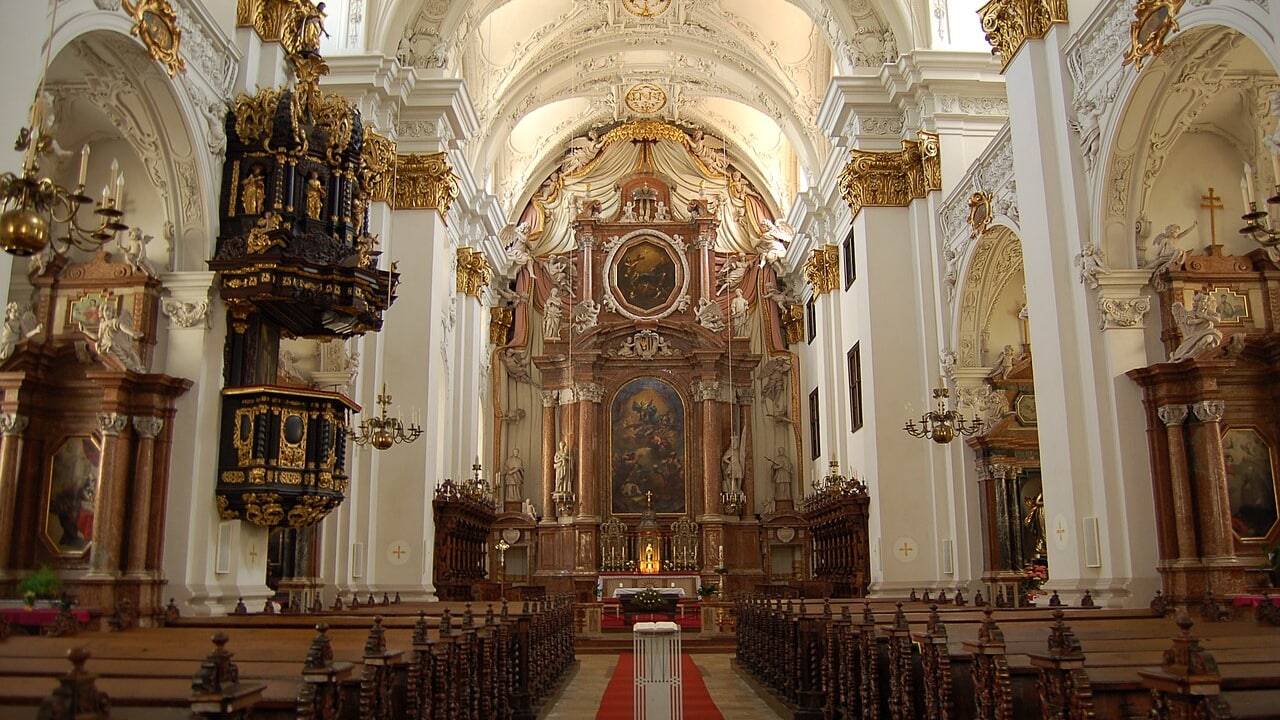
Featured Image: The altar of the Old Cathedral of Linz