Mozart’s String Quartet No. 19 in C Major, “Dissonance”: The Sixth Child

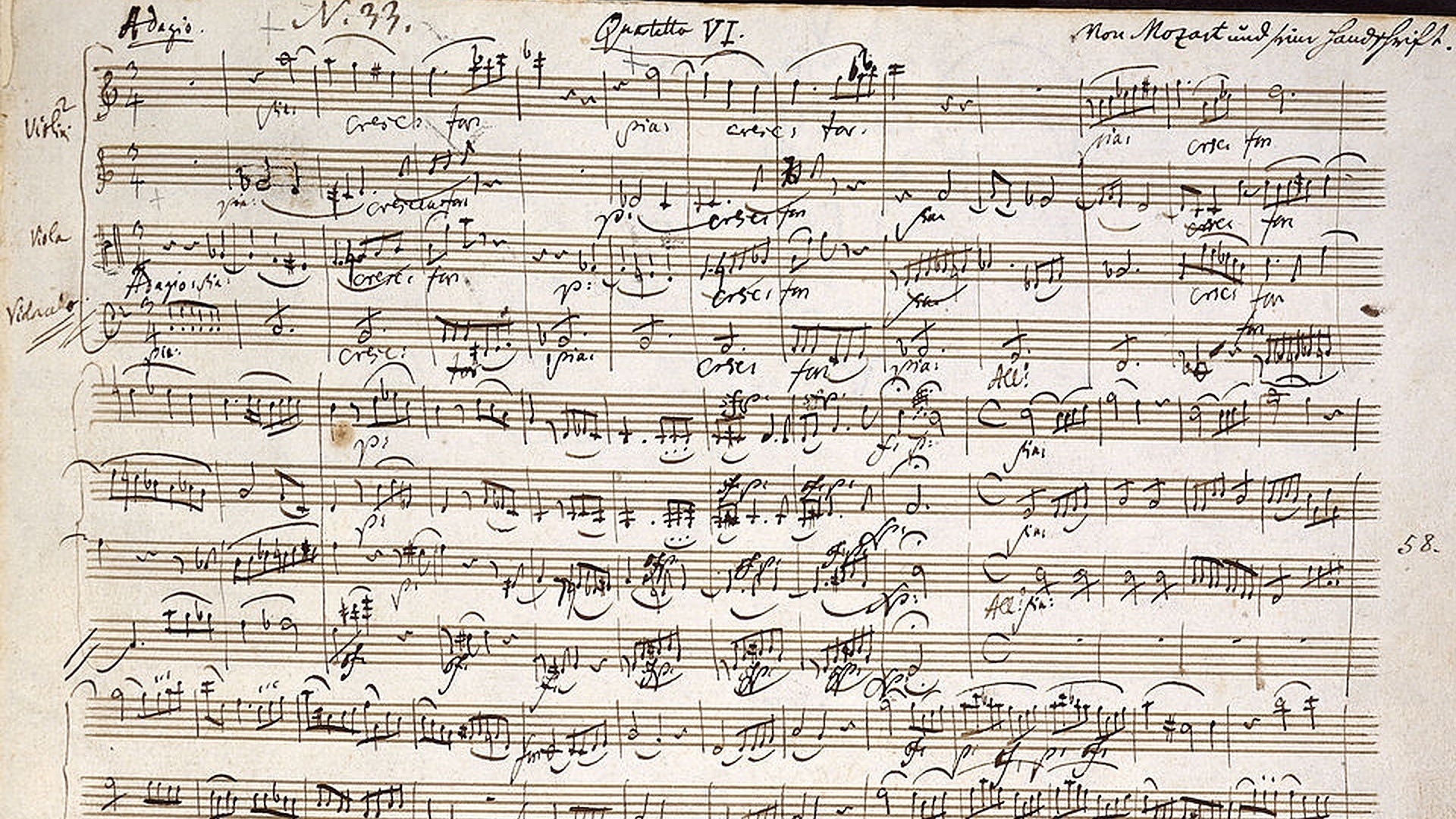
The introduction which opens the first movement of Mozart’s String Quartet No. 19 in C Major, K. 465 foreshadows the mystery and Romantic pathos of late Beethoven. At moments, it even flirts with the twentieth century atonality of Arnold Schoenberg. In the first bars, the viola and two violins enter, one at a time, over a pulsating “C” in the cello. Their chromatic lines wander across a haunting and barren landscape, shrouded …

Read more

Mozart’s Sinfonia Concertante for Violin, Viola, and Orchestra: A Sublime Hybrid

Listen to the instrumental music of Mozart, and you may hear the unfolding of a virtual opera without words. Transcending mere vocal virtuosity, Mozart’s greatest operas offer layers of character development and dramatic sophistication. The instrumental lines of the orchestra rise to new prominence and engage with the voices onstage to create a magically enhanced drama. The literal reality of the story meets a deeper poetic reality. Boundaries are blurred and musical …

Read more

Beethoven’s “Triple Concerto”: Chamber Music on a Grand Scale

Beethoven’s Concerto for Violin, Cello, and Piano in C Major, Op. 56 is a rare musical hybrid. Commonly known as the Triple Concerto, it playfully and exuberantly combines elements of the piano trio with the concerto. With this music, Beethoven achieved a genre-bending feat which was virtually unprecedented at the time, and has not been attempted by any significant composer since. While the sinfonia concertante features a dialogue between individual solo instruments and the …

Read more

Haydn’s Symphony No. 102 in B-flat Major: Dynamic and Miraculous

According to legend, during the premiere of Franz Joseph Haydn’s Symphony No. 96, a chandelier fell from the ceiling at London’s Hanover Square Rooms. Moments earlier, enthusiastic audience members rushed the stage to catch a better glimpse of Haydn, who conducted from the pianoforte. As a result, everyone escaped serious harm. Shouts of gratitude rang out. “Miracle! Miracle!” Symphony No. 96 earned the nickname, The Miracle.  In fact, this harrowing event occurred four …

Read more

Haydn’s Cello Concerto No. 1 in C Major: Steven Isserlis in Frankfurt

The British cellist, Steven Isserlis, has called Franz Joseph Haydn’s Cello Concerto No. 1 in C Major, “the greatest Classical cello concerto. It’s full of joy, of joyous virtuosity. It’s perfect.” Haydn wrote this music in the early 1760s, around the time that he began employment as music director at the court of Prince Nikolaus Esterházy. During the same time period, Haydn produced his first symphonies, while he expanded and refined the Esterházy Orchestra. The …

Read more

Mozart’s Piano Concerto No. 19: Mitsuko Uchida and the Cleveland Orchestra

Mozart’s mature piano concertos are sublime dramas without words. They are filled with a magical sense of instrumental conversation. Each phrase seems to have drifted out of some imaginary opera scene in which literal meaning has been replaced with a deeper and more fundamental expressive reality. The instrumental voices form a rich and colorful cast of characters. Blurring the boundaries between solo and accompaniment, the solo piano and orchestral voices engage as equals. We …

Read more

Beethoven’s “The Ruins of Athens”: Politics and the Triumph of the Muses

In 1811, Beethoven received a commission to compose incidental music for two Hungarian-themed plays by August von Kotzebue, King Stephen and The Ruins of Athens. The plays were written to commemorate the opening of a magnificent new theater in the Hungarian city of Pest on the banks of the Danube (now the eastern part of unified Budapest). The theater’s construction was funded by Franz I, the last Holy Roman Emperor and the first …

Read more